一般的に、「June 23」と書きますが、「June 23rd(June twenty-third)」と読みます。
書面:
The meeting will be held on June 23.
口頭:
“The meeting will be held on June twenty-third.”
※「23rd of June(twenty-third of June)」ということも可能です
難易度:5/10
関連リンク:「Day」と「date」の違いは何ですか?
一般的に、「June 23」と書きますが、「June 23rd(June twenty-third)」と読みます。
書面:
The meeting will be held on June 23.
口頭:
“The meeting will be held on June twenty-third.”
※「23rd of June(twenty-third of June)」ということも可能です
難易度:5/10
関連リンク:「Day」と「date」の違いは何ですか?
一般的に「Please give him my regards」といいます。
Please give Mr. Jones my regards.
Jonesさんによろしくお伝えください。
カジュアルに「Can you tell him that I said hi?」または「Say hello to him (for me)」ということもできます。
難易度:5/10
関連リンク:「久しぶり」とは何といいますか?
一般的に「person diagonally in front of me to the right」といいます。尚、「(自分の)斜め左後ろにいる人」などは、以下のように表します。
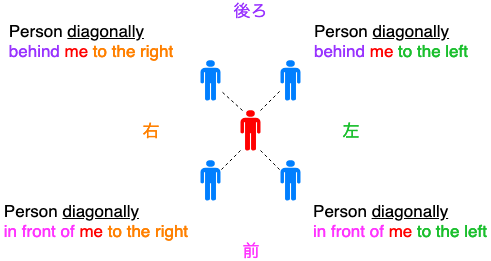
難易度:7/10
関連リンク:「一番上の(もの)」といいたい場合、どのようにいえばよいでしょうか?
①「<」は、「less than」と読みます。
x < 12
x is less than twelve.
②「≤」は、「less than or equal to」と読みます。
x ≤ 34
x is less than or equal to thirty-four.
③「>」は、「greater than」と読みます。
x > 12
x is greater than twelve.
④「≥」は、「greater than or equal to」と読みます。
x ≥ 34
x is greater than or equal to thirty-four.
難易度:5/10
関連リンク:割り算「6 ÷ 2」はどのように読みますか?
一般的にアメリカでは、以下のように記載します。
「曜日」のみの場合:
The meeting will be held on Wednesday.
「日付(月と日)」のみの場合:
The meeting will be held on June 5.
*「June the 5th」または「June 5th」と記載する人もいます
「曜日」と「日付」の場合:
The meeting will be held on Wednesday, June 5.
「曜日」、「日付」、「年」の場合:
The meeting will be held on Wednesday, June 5, 2019.
また、「月」がない「日付」の場合は、序数を使用して以下のように記載します。
The meeting will be held on the 5th.
また、上記それぞれに時刻を追加したい場合、「on…」の前後いずれかに「at + 時刻」を追加します。
例:
The meeting will be held on Wednesday, June 5 at 3 p.m.
または
The meeting will be held at 3 p.m. on Wednesday, June 5.
難易度:5/10
関連リンク:アメリカで日付を表す場合、「07/04/16」は、いつを表しますか?
「pollen allergy」ともいいますが、「hay fever」の方がアメリカでは一般的に使用されます。
Tom hates spring because he has hay fever.
Tomは花粉症なので、春が大嫌いである。
参考:NIH (国立衛生研究所)
難易度:5/10
関連リンク:英語で「インフルエンザ」はどのようにいいますか?
いいえ、「I am scary」だと「私は怖い(おっかない)人物である」という意味になってしまいます。「私は怖がっている」といいたい場合は、「I am scared」と表現します。
Since I usually don’t express my emotions, people think that I am scary.
私は通常感情を露わにしない為、人々は私が怖い人だと思っている。
I am scared of ghosts.
私はお化けが怖い。
※上記の「scared」は「怖がっている(状態)」を表す形容詞です。
尚、「I scared」と能動態の過去形にした場合、「私は怖がらせた」という意味になります。
I scared my friend with my Halloween costume.
私はハロウィンの衣装で友達を怖がらせた。
難易度:5/10
関連リンク:「I am dangerous」で、「私は危ない(状況にいる)」という意味になりますか?
一般的に以下のように表します。
「主語 + 現在完了形の否定(hasn’t/haven’t + 過去分詞)+ for a while」
We haven’t talked for a while.
私たちは、しばらく話していません。
また、「◯年」のように、具体的な期間に変えることも可能です。
「主語 +現在完了形の否定(hasn’t/haven’t + 過去分詞)+ for + 基数 + year(s)」
I haven’t gone to karaoke for (the past) 5 years.
私は、(この)5年間カラオケに行っていない。
難易度:6/10
関連リンク:「during」と「while」は入れ替えて使用することができますか?
一般的に以下のように表します。
「It’s been a while since + 主語 + last + 動詞の過去形」
It’s been a while since we last talked.
私たちが最後に話してから、しばらく経っている。
また、「◯年」のように、具体的な期間に変えることも可能です。
「It’s been + 基数 + year(s) + since + 主語 + last + 動詞の過去形」
It’s been 5 years since we last went to karaoke.
私たちが最後にカラオケに行ってから、5年経っている。
難易度:6/10
関連リンク:「In the end」と「at last」の違いは何ですか?
一般的に以下のように表します。
「主語 + 動詞の過去形 + for the first time in a while」
We talked for the first time in a while.
私たちは、久しぶりに話した。
また、「◯年ぶり」のように、具体的な期間に変えることも可能です。
「主語 + 動詞の過去形 + for the first time in + 基数 + year(s)」
I went to karaoke for the first time in 5 years.
私は、5年ぶりにカラオケに行った。
難易度:6/10
関連リンク:「Awhile」と「a while」の違いは何ですか?